∞∞∞∞∞∞∞
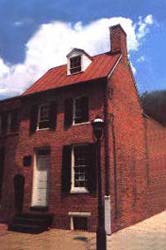
The Poe House and Museum (in Baltimore, Maryland), about 1980.
The little house at 203 Amity street (originally No. 3 Amity) was presumably built around 1830 for Charles Klassen. Late in 1832 or early in 1833, Maria Clemm (aged 43) moved from East Baltimore to the countryside. Her household included herself, her ailing mother (Elizabeth Cairnes Poe, aged 73), her daughter (Virginia Eliza Clemm, aged 10) her nephew (Edgar Allan Poe, aged 23) and perhaps her son (Henry Clemm, aged 14). (Henry Clemm should not be confused with Poe’s brother, also named Henry, who died in 1831. Little is known about Henry Clemm, who, according to Amelia F. Poe was born on September 10, 1818 and “died young and unmarried.” Henry appears to have been working in a granite yard in Baltimore about 1835, presumably as an unskilled laborer, and to have gone to sea by 1836. After 1836 there seems to be no further mention of him, and it is probable that he died at sea or in some distant land. According to Amelia Poe, in a 1910 letter to John H. Ingram, Henry Clemm died young and unmarried.) Maria Clemm rented the house primarily with money from her mother’s government pension, awarded in recognition of Major David Poe, Sr.’s prominent service during the Revolutionary War. (David Poe was the Quartermaster General for the city of Baltimore.) Edgar A. Poe left this house in August or September of 1835, moving to Richmond, Virginia to edit the Southern Literary Messenger. About the same time, Elizabeth Cairnes Poe died and her pension stopped. Maria was quickly unable to cover the rent and had no option other than to move. Edgar’s cousin Neilson Poe, who lived in Baltimore and had married Virginia’s half-sister, offered to take in both Virginia and Maria. Edgar, fearing that he was losing his little family, proposed to Virginia in a remarkably emotional letter, dated August 29, 1835. She accepted and by October 7, 1835 Virginia and Maria moved with Poe to Richmond.
Learning that the area was scheduled for demolition in 1941, the Edgar Allan Poe Society of Baltimore identified the building Poe and Mrs. Clemm had lived in, and was able to convince the City of Baltimore to modify the development project to preserve the house. After years of discussion and planning, and a series of delays caused by legal issues and changes in personnel in city government, the Poe Society was finally able to arrange a tentative five-year agreement in November 1945, for a token rent of $5.00 per year. The City of Baltimore, however, required the Poe Society to be incorporated prior to finalizing the lease. Incorporation was achieved, and the lease was finally signed on July 23, 1946. The house required extensive repairs (including the replacement of the wooden steps leading up to the front door), cleaning, electical wiring, replastering and painting before it could be openned to the public. The costs almost completely drained the society’s funds for three years, but the house was finally opened in 1949, just in time for the centennial of Poe’s death, and the Poe Society subsequently ran the museum for nearly three decades. (Initially, admission was charged at 25¢ for adults, and 10¢ for students.) In 1977, the Poe Society, already struggling to maintain the house and provide volunteers as tour guides, realized that more than $90,000 in repairs on the building were required, far more than it could possible afford. At that point, the City of Baltimore’s Commission for Historical and Architectural Preservation (CHAP) graciously agreed to take on full responsibility for the museum. (Under CHAP, Jeff Jerome served as the curator of the museum.) As of September 26, 2012, ownership of the house was turned over to the Baltimore City Department of General Services, and responsibility for the museum was transferred to a new organization, Poe Baltimore, which was established specifically for this purpose. After additional rennovations, the house reopened for weekend hours on October 5, 2013.
The photograph at the upper right was taken about 1980, showing the Baltimore Poe House as it appears today. To the left is a row of houses erected in 1938 under the Housing Authority of the city of Baltimore. The second half of the duplex, which would have been on the left when Poe lived here, was removed during construction of these newer homes. (For a drawing showing the house as it originally appeared, see below, under images.)
∞∞∞∞∞∞∞
Description:
The house is a small 2 1/2 story brick duplex (now part of a row of houses), containing 5 rooms. First floor: parlor (front) and kitchen (rear). Second floor: 2 bedrooms. Top floor: 1 bedroom (assigned by most biographers as Poe’s room, although others believe that he used the rear bedroom and that Virginia used the small attic bedroom). The stairs for both floors are very narrow and winding, especially those leading to the top floor. At some point after Poe’s residence, the back of the building was extended by about 4 feet. This extension remains, although the original size can be seen in the changing floorboards. All interior walls and ceilings are horse-hair plaster, probably whitewashed during Poe’s day. (The walls, ceilings and mantels are currently painted off-white, with all wood elements painted brown.) All rooms have uneven wooden plank flooring, two covered with carpeting. All doors, mantels, baseboards and related trim work are wood. There are three fireplaces in the house, two on the first floor (kitchen and parlor) and one on the second (front bedroom). The fireplaces in the parlor and bedroom share the same chimney. All fireplaces are lined with brick and have brick hearths.
∞∞∞∞∞∞∞
Displays:
The primary item on display is the house itself. In addition, a number of pieces related to Poe are exhibited, including glassware and china belonging to John Allan (Poe’s foster father), a telescope reputedly used by Poe, a traveling desk (or lap desk) and a modest Winsor chair that desended through the family of Poe’s uncle, Henry Herring, and which may have been in the house during Poe’s residence. Various informational displays are spread throughout the building Some furniture of the period, although not Poe’s, is also exhibited, primarily on the top floor.
∞∞∞∞∞∞∞
Writings Presumably Penned in This House:
Determining the exact dates of composition for Poe’s works is often complicated since some early works were rejected by publishers for several years. Chief among these were the eleven stories Poe had written as a collection he called “Tales From the Folio Club.” Although it was always Poe’s intent that these stories would be printed as a set, with each tale reflecting a different narrator in the style of Chaucer’s “Canterbury Tales,” he was unable to find a publisher and was forced by financial necessity to print them out of context as individual pieces. It is reasonable to assume that the following items were written during his stay on Amity Street.
Stories:
- “MS. Found in a Bottle” (Baltimore Saturday Visiter, October 26, 1833)
- “The Visionary” (Submitted to the Baltimore Saturday Visiter in 1833. First published in Godey’s Lady’s Book for Jan. 1834)
- “Lion-izing. A Tale” (Southern Literary Messenger, May 1835)
- “Shadow-A Parable” (Southern Literary Messenger, September 1835)
- “Siope. A Fable” (Manuscript before May 4, 1833. First published in The Baltimore Book, a Christmas and New Year’s Present, 1838)
- “Berenice — A Tale” (Southern Literary Messenger, March, 1835)
- “Morella” (Manuscript, about 1835. First published in Southern Literary Messenger, April 1835)
- “King Pest the First. A Tale containing an Allegory” (Mabbott assigns a probable date of 1834. First published in Southern Literary Messenger, September 1835)
- “Hans Pfaall — A Tale” (Manuscript presumed as April or May, 1835; Southern Literary Messenger, June, 1835)
Poems:
- “Latin Hymn” (Manuscript, May 4, 1833)
- “Enigma [on Shakespeare]” (Baltimore Saturday Visiter, Feb. 2, 1833)
- “Serenade” (Baltimore Saturday Visiter, April 20, 1833)
- “To — [Sleep on]” (Baltimore Saturday Visiter, May 11, 1833)
- “Fanny” (Baltimore Saturday Visiter, May 18, 1833)
- “The Coliseum” (Baltimore Saturday Visiter, October 26, 1833)
- “To Elizabeth” (Manuscript from the album of Elizabeth Rebecca Herring, 1833)
- “To Mary [Winfree]” (Southern Literary Messenger, July 1835)
Reviews and Editorial Items:
Because reviews and editorial material at this period are typically unsigned, it is particularly difficult to assign Poe’s authorship, except in special cases. For the reviews of Confessions of a Poet and Horse-shoe Robinson, for example, Poe specifically accepted authorship in extant letters.
- “[Review of R. M. Bird’s Calavar]” (Southern Literary Messenger, February 1835)
- “[Review of Laughton Osborn’s Confessions of a Poet]” (Southern Literary Messenger, April 1835)
- “[Review of J. P. Kennedy’s Horse-Shoe Robinson]” (Southern Literary Messenger, May 1835)
- “[Notice of the 8th issue (April) of the Southern Literary Messenger]” (The Baltimore Republican and Commercial Advertiser, May 14, 1835)
- “[Review of R. M. Bird’s The Infidel]” (Southern Literary Messenger, June 1835)
- “[Notice of the 9th issue (May) of the Southern Literary Messenger]” (The Baltimore Republican and Commercial Advertiser, June 13, 1835)
- “[Notice of the 9th issue (May) of the Southern Literary Messenger]” (The Baltimore American, June 15, 1835)
- “[Notice of the 10th issue (June) of the Southern Literary Messenger]” (The Baltimore Republican and Commercial Advertiser, July 10 1835)
∞∞∞∞∞∞∞
∞∞∞∞∞∞∞
Hours of Operation:
The Baltimore Poe House and Museum will be offically opening for the 2014 season in May. As details are determined, hours of operation will be posted at the Poe Baltimore website.
∞∞∞∞∞∞∞
Directions:
The Baltimore Poe House and Museum is located at 203 Amity Street in West Baltimore. (See map under Images.)
From the Poe Grave: Head west on Fayette, past Martin L. King Blvd. to Schroeder Street. Turn right on Schroeder for 2 blocks to Saratoga. Turn right on Saratoga and go for about 1/2 a block to Amity. Amity is the 1st street on right (only). Turn right on Amity and look for the Poe House on the left side, near the end of the block. (A tall black antique-styled lamp stands in front of the house.)
From the Inner Harbor, south of town: Take Charles Street (one way) north to Fayette. Turn left on Fayette. From there, follow instructions above.
Parking: Free on-street parking is available on Amity, right outside of the Poe House. Please knock on the front door of the Poe House for admittance.
Note: Use caution when parking in an urban environment. Common sense dictates that you lock your car and keep any valuables out of sight.
∞∞∞∞∞∞∞
∞∞∞∞∞∞∞
- Clemm, Mrs. Maria, “[Letter to William Poe],” October 1835 (This letter documents that Henry Clemm was working in a stone-cutter’s yard in Baltimore. Portions of the letter are quoted by Mary Phillips in EAP: The Man, 1926, 1:514-515. J. A. Harrison (1902, 17:379-381) quotes what seems to be the same letter, but slightly modifies some wording and omits some of the sentences given by Miss Phillips, including the statement about Henry.)
- Evans, May Garrettson, “Poe in Amity Street,” Maryland Historical Magazine, December 1941, Vol. XXXVI, No. 4, pp. 363-380.
- Jackson, David K., “Four of Poe’s Critiques in the Baltimore Newspapers,” Modern Language Notes, April 1935, pp. 251-256.
- Mabbott, Thomas Ollive, ed, The Collected Works of Edgar Allan Poe; (Vols 1 - Poems, Vols 2 & 3 - Tales and Sketches) Cambridge, Mass.: The Belknap Press of Harvard University Press, Vol. 1 - 1969 (Second printing 1979), Vols 2-3 - 1978.
- Ostrom, John Ward, ed, The Letters of Edgar Allan Poe; 2 Vols. New York: Gordian Press, 1966. (Especially the following letters: Poe to William Poe, August 20, 1835, 1:66-69; Poe to Maria and Virginia Clemm, August 29, 1835, 1:69-71; Poe to J. P. Kennedy, Jan 23, 1836, 1:81-83.)
- Poe, Amelia Fitzgerald, “[Letter to J. H. Ingram],” July 12, 1910 (MS in the Ingram Collection, UVA).
- Pollin, Burton R and Joseph V. Ridgely, The Collected Writings of Edgar Allan Poe: Volume 5: Writings in The Southern Literary Messenger, Nonfictional Prose, New York: The Gordian Press, 1997.
- Thomas, Dwight and David K. Jackson, The Poe Log: a Documentary Life of Edgar Allan Poe, 1809 - 1849, Boston: G.K. Hall & Co., 1987.
∞∞∞∞∞∞∞
[S:1 - JAS] - Edgar Allan Poe Society of Baltimore - Baltimore - Poe House and Museum