∞∞∞∞∞∞∞
The information below was taken from a press release “Testing Poe’s Hair” from April 9, 2006. A few minor changes have been made to accomodate the changes in formatting necessary for a webpage presentation. Photographs given in black and white in the press release appear in full color here, including the addition of a closeup of the lock of E. A. Poe’s hair. The table of results was not included in the original press release.
For over 150 years, Poe’s death and the general state of his health have been topics of much interest and discussion. Recognizing advances in science and the potential of adding specific details to the already well-known information, the Edgar Allan Poe Society of Baltimore agreed to sacrifice 3 strands each of hair from Virginia and Edgar for heavy metal analysis. These strands were from locks cut following their deaths in 1847 and 1849, respectively, in accordance with the 19th century practice of preserving memento mori. The locks were kept by the Herring branch of the Poe family until 1936, when Mrs. Ella L. Warden donated them, along with a number of other relics, to the Poe Society. (These items are currently on deposit at the Enoch Pratt Free Library. (Photographs of the locks are shown below.)
The study was designed by Albert Donnay, an environmental health engineer in Baltimore, and funded by Alliance Atlantis of Toronto, Ontario (which is producing a program on Poe for a series called “Dead Men’s Tales,” to be aired on the Discovery Health cable channel in 2003). Testing was performed by Dr. John Ejnik and Dr. Jose Centeno at the Department of Environmental and Toxicologic Pathology, US Armed Forces Institute of Pathology in Washington D. C. In 1999, the same laboratory published an analysis of lead and mercury in the hair of President Andrew Jackson (1767-1845).
The purpose of this study was to determine the levels of various toxic heavy metals in the hair of Edgar and Virginia Poe using Inductively Cooled Plasma Mass Spectrometry, which is capable of detecting extremely low concentrations. Possible sources of heavy metal exposure in Poe’s era included drinking water, alcohol, food, cosmetics, patent medicines and illuminating gas lighting, which was made from coal. Since the accumulation of metals in hair varies with exposure and over time, the researchers analyzed the two ends of each hair sample separately. Additionally, the length of Virginia’s hair sample allowed testing of a third, middle section.
One of the chief difficulties in this study is estimating the time-frame reflected by the samples. Assuming normal hair growth, Edgar’s 2” long sample probably represents 2.5 to 5 months in the last year of his life. Virginia’s 15” long sample represents 1.6 to 3.2 years, beginning when they lived in New York City and ending when they lived in the Fordham cottage where she died. Although both samples were taken after death, the hair was cut from the free end rather than from the scalp, and the distance from the scalp is unknown. We cannot be sure, therefore, how many months of hair growth leading up to the time of their deaths are not included in this analysis. At least 1 month and perhaps as many as 5 months are presumed. For Edgar, no toxically high levels were found of any of the metals studied, although notable changes were registered in his exposure over time. For Virginia, the levels found were more significant, and she also experienced major changes over time.
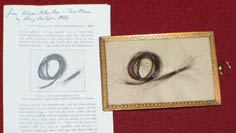
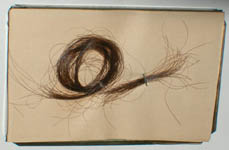
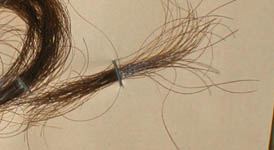
These locks of hair are from Virginia Poe (larger) and Edgar A. Poe (smaller), and as shown in Mary Phillips, Edgar Allan Poe, The Man (1926). The hair in both locks is brown. To the far right is a closeup of the lock of E. A. Poe’s hair. (Photograph by Jeffrey A. Savoye, Edgar Allan Poe Society of Baltimore)
Arsenic: The levels of arsenic in Edgar’s hair were 15 times today’s normal level, and about 2/3 the level associated with symptoms of arsenic poisoning. They did not change significantly over time. Virginia’s hair started at 45 times the normal level today, and twice the level associated with arsenic symptoms, but fell 66%, ultimately ending at a level almost identical to Edgar’s. Since they were in Fordham by this time, and Edgar was still living in the same house two years later, the researchers believe they most likely ingested similar levels of arsenic from environmental sources, such as their drinking water. The much higher level of arsenic collected in the oldest portion of Virginia’s hair could have been due to higher levels of arsenic in either their water supply while living elsewhere and/or the coal used to make illuminating gas.
Lead: Edgar’s lead level fell 33% over the same period, showing that he dramatically reduced his exposure, which in that era would have been primarily from wine and/or patent medications. Although the levels of lead at both ends of his hair sample are 3 to 4 times higher than today’s normal level, they are not high enough to cause symptoms of lead poisoning. But the lead levels in Virginia’s hair ranged from 10 to 13 times higher than today’s normal level -- higher even than the levels found in President Andrew Jackson’s hair after he was shot with two lead bullets -- and are at the low end of levels associated with symptoms of lead poisoning. (Jackson’s lead level dropped dramatically after the removal of the bullets.) Since Edgar and Virginia’s lead levels in Fordham were so substantially different, the researchers believe they are more likely due to some specific form of exposures (such as cosmetics or medications) rather than environmental sources (such as polluted air or water).
Mercury: Edgar’s mercury level increased over a few months by 264%, probably due to the calomel he wrote of taking while in Philadelphia. But even at its highest point, it was still more than 30 times below the level associated with symptoms of mercury poisoning, and only1/2 the level found in President Andrew Jackson’s hair, who (like Poe) was known to have taken calomel medication. Virginia’s mercury level, however, started at a level about that of President Jackson and gradually increased 22%, suggesting that she and Edgar had very different personal exposures.
Nickel: The oldest nickel level in Edgar’s hair was 10 times today’s normal level, and fell 66% as he aged. Although it was higher than normal, it was not high enough to produce symptoms of nickel poisoning. Virginia’s nickel level also fell but by 98.7%, from a level higher than Edgar’s to 20 times lower, suggesting that they had different sources of personal rather than just environmental exposure.
Uranium: The levels of uranium in Edgar’s hair were below the detection limit of the instrument for the size of the samples, which means they contained less than about 8 parts per billion (=0.008 ppm). But the level of uranium in Virginia’s hair when she lived in gas-lit New York City was very high, similar to that found in uranium miners, and approximately 15 times today’s normal level. It was also 100 times the level found in the middle section of her hair. As with Edgar, no uranium was detectable in the end of her hair that grew while living in gas-free Fordham. Since the most likely source of her uranium exposure in New York City was illuminating gas made from coal, to which Edgar also would have been exposed, the researchers conclude that the both she and Edgar were significantly exposed to gas lighting there before they moved to Fordham, where they had no detectable exposure to coal gas or any other sources of uranium.
Vanadium: The levels of vanadium in Edgar and Virginia’s hair were both at the high end of the normal range and neither changed significantly, showing that vanadium apparently cannot be used as a biomarker of illuminating gas exposure.
| Hair Sample | Mercury |
Lead |
Arsenic |
Nickel |
Uranium |
Vanadium |
| ------------------------- | --------------- |
--------------- |
--------------- |
--------------- |
--------------- |
--------------- |
| Virginia Poe-O Virginia Poe-M Virginia Poe-N |
5.52 5.62 6.76 |
160.636 155.432 123.704 |
10.517 6.207 3.494 |
11.46 none 0.15 |
0.1500 0.0014 <0.0062 |
0.245 0.118 0.210 |
| -------------- | ||||||
| Edgar A. Poe-O Edgar A. Poe-N |
1.46 3.86 |
51.045 34.508 |
3.642 3.371 |
7.17 2.80 |
<0.0075 <0.0081 |
0.104 0.097 |
| -------------- | ||||||
| Andrew Jackson-O Andrew Jackson-N |
6.00 5.60 |
130.500 69.000 |
na na |
na na |
na na |
na na |
| -------------- | ||||||
| Healthy Control Modern Normal Symptom Threshold |
0.66 0.77 >125.00 |
5.725 12.210 >150.000 |
0.085 0.200 >5.000 |
2.08 0.74 na |
0.0170 0.0100 na |
0.021 0.185 na |
| -------------- | ||||||
Notes: -O/-M/-N = Oldest/Middle/Newest section of the hair sample "na" = not available ">" = greater than "<" = less than |
||||||
∞∞∞∞∞∞∞
[S:1 - JAS] - Edgar Allan Poe Society of Baltimore - General Topics - Test Results of Edgar Allan Poe’s Hair