∞∞∞∞∞∞∞
Sections: Biography Criticism Bibliography
∞∞∞∞∞∞∞
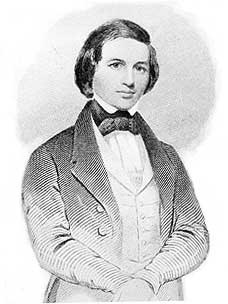
Timothy Shay Arthur
(Born: June 6, 1809 - Died: March 6, 1885)
American author, novelist, journalist, publisher and editor. Born near Newburgh, NY. His parents, William and Anna Shay Arthur, were deeply religious. They moved to Baltimore, MD in 1817. Having been a very poor student, and suffering from an eye aliment which was to plague him for much of his life, his chosen career may be surprising. Having worked for three years as a clerk in a Baltimore countinghouse, he moved briefly to Louisville, KY, but after a few weeks returned to Baltimore. Later in 1833, he was invited by John McJilton to join him as an editor of the Baltimore Athenaeum and Young Men’s Paper, which ran until September 1836. In this same year, he married Eliza Alden, the daughter of a very prominent family, and a descendant of John and Priscilla Alden. On October 8, 1836, he founded the Baltimore Literary Monument, for which he was the publisher, and he served again as editor along with his old friend John McJilton. It began as a weekly but became a monthly for its final issues. (It ran until October 1839.) In 1837, he acquired the Baltimore Saturday Visiter, which he continued to publish until 1840, when he became an edtor of the Baltimore Merchant. He moved to Philadelphia, PA in 1840 or 1841, where he remained for the rest of his life. In February 1844, he became an editor of the Ladies’ Magazine of Literature, Fashion and the Fine Arts, which became Arthur’s Ladies’ Magazine of Elegant Literature and the Fine Arts in 1845. It ceased publication in July 1846. In 1850, he began Arthur’s Home Gazette, which changed from a weekly to a monthly in 1853 as Arthur’s Home Magazine. During his long career, he contributed to many periodicals of the day, beyond those he edited, including Graham’s Magazine, Godey’s Lady’s Book, the Knickerbocker, the Ladies’ Garland, the Columbian Lady’s and Gentleman’s Magazine, the Union Magazine and the Christian Parlor Magazine. He published more than 150 novels, many of which featured an overtly moral message. He was a supporter of temperance, and among his voluminous works, the most famous is The Nights in a Bar-Room and What I Saw There (1854), which was often used for temperance lectures. So popular was this work that he followed it up with two sequels, Three Years in a Mantrap (1872) and The Bar-Rooms at Brantley (1877). In the 1870s, Arthur himself helped to establish the Franklin Home for Inebriates in Philadelphia. He died in Philadelphia at the age of 75 from anemia and kidney disease, and was buried in the old Chestnut Street Cemetery.
Whether or not Poe knew Arthur personally is a matter of debate, although they were both living in Baltimore in the early 1830s. In a letter of July 12, 1841 to J. E. Snodgrass, Poe comments: “I never had much opinion of Arthur. What little merit he has is negative.”
- Notice from “Autography”
- “T. S. Arthur” (“A Chapter on Autography” - part II) — December 1841 — Graham’s Magazine
∞∞∞∞∞∞∞
- Anonymous, “Godey’s Portrait Gallery — No. I: T. S. Arthur,” Godey’s Lady’s Book, November 1844, 29:193-194 (with an engraved portrait)
- Duyckinck, E. A. and G. L., “T. S. Arthur,” Cyclopedia of American Literature, New York: Charles Scribner, 1856, 2:601-602
- Heartman, Charles F. and James R. Canny, A Bibliography of First Printings of the Writings of Edgar Allan Poe, Hattiesburg, MS: The Book Farm, 1943.
- Koch, Donald A., “Timothy Shay Arthur,” Dictionary of Literary Biography, vol. 3., Antebellum Writers in New York and the South, ed. Joel Myerson, Detroit: Gale Research, 1979, 3:3-6
- Mabbott, Thomas Ollive, ed., The Collected Works of Edgar Allan Poe (Vols 2-3 Tales and Sketches) , Cambridge, Mass.: The Belknap Press of Harvard University Press, 1978. (Second printing 1979)
- Mott, Frank Luther, A History of American Magazines, New York, D. Appleton and Co., 1930, 1:381, 733-734, etc.
- Thomas, Dwight and David K. Jackson, The Poe Log: A Documentary Life of Edgar Allan Poe 1809-1849, Boston: G. K. Hall & Sons, 1987.
- Warner, Charles Dudley, ed., “Biographical Dictionary of Authors,” Library of the World’s Best Literature, New York: The International Society, 1896, 42:27 (a brief entry)
- Wilson, James Grant and John Fiske, eds., Appleton’s Cyclopedia of American Biography, New York: D. Appleton & Co., 1889, 1:107.
∞∞∞∞∞∞∞
[S:0 - JAS] - Edgar Allan Poe Society of Baltimore - People - Timothy Shay Arthur