∞∞∞∞∞∞∞
Sections: Biography Letters Bibliography
∞∞∞∞∞∞∞
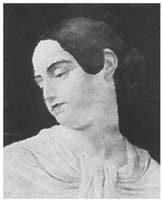
Mrs. Virginia Clemm Poe
(Born: August 15, 1822 - Died: January 30, 1847)
“Mrs. Poe looked very young; she had large black eyes, and a pearly whiteness of complexion, which was a perfect pallor. Her pale face, her brilliant eyes, and her raven hair gave her an unearthly look. One felt that she was almost a disrobed spirit, and when she coughed it was made certain that she was rapidly passing away” (Mrs. Mary Gove Nichols, “Reminiscences of Edgar Allan Poe,” reprint, p. 8).
“One of his [Poe’s] severe chroniclers says: ‘It is believed by some that he really loved his wife; if he did, he had a strange way of showing his affection.’ Now it appears to me that he showed his affection in the right way, by endeavoring to make his companion happy. According to the opportunities he possessed, he supplied her with the comforts and luxuries of life. He kept a piano to gratify her taste for music, at a time when his income could scarcely afford such an indulgence. I never knew him to give her an unkind word, and doubt if they ever had any disagreement. that Virginia loved him, I am quite certain, for she was by far too artless to assume the appearance of an affection which she did not feel” (Lambert A. Wilmer, 1866).
“The day before Mrs. Poe died I left to make some arrangements for her comfort. She called me to her bedside, took a picture of her husband from under her pillow kissed it and gave it to me. She opened her work box and gave me the little jewel case I mentioned to you.” (Mrs. Shew to Ingram, March 28, 1875.)
“When his wife died Mr. Poe took it might hard. She was buried up in the old Dutch cemetery but they afterward moved her to Baltimore . . . . He used to cry over her grave every day and kept it green with flowers.” (Mrs. Rebecca Cromwell, a former Fordham neighbor, quoted in “Edgar Poe’s Cottage,” Scranton Republican, June 21, 1883, p. 2, col. 3, reprinted from the New York Herald, and reprinted in K. W. Cameron, The New England Writers and the Press, 1980, p. 64.) (Curiously, Mrs. Cromwell was under the impression that Virginia’s remains had been moved to Baltimore about 1878, although this did not occur until 1885.)
∞∞∞∞∞∞∞
- E. A. Poe to M. and Virginia Clemm - August 29, 1835 (OL#48) (embedded in this heartbreaking letter to Maria Clemm is a proposal to Virginia)
- E. A. Poe to Virginia Poe - June 12, 1846 (OL#232)
∞∞∞∞∞∞∞
- Houghton, Marie L. [Mrs. Shew], letter to John H. Ingram, March 28, 1875, reprinted in John C. Miller, Building Poe Biography, p. 116.
- Mabbott, Thomas Ollive, “Poem by Poe’s Wife,” Collected Works of Edgar Allan Poe, Volume I: Poems, Cambridge: The Belknap Press of Harvard University Press, 1969, pp. 523-525.
- Nichols, Mrs. Mary Gove, “Reminiscences of Edgar Allan Poe,” Sixpenny Magazine, February, 1863. (Reprinted, New York: The Union Square Book Shop, 1931.)
- Weiss, Mrs. Susan A. T., “The Real Virginia,” The Home Life of Poe, New York: Broadway Publishing, 1907, pp. 90-93.
- Wilmer, Lambert A., “Recollections of Edgar A. Poe,” Daily Commercial (Baltimore), May 23, 1866, vol. I, no. 200, p. 1, col. 5. (Reprinted by T. O. Mabbott, Merlin, Together with Recollections of Edgar A. Poe, New York: Scholar’s Facsimiles & Reprints, 1941, pp. 28-34.)
∞∞∞∞∞∞∞
[S:0 - JAS] - Edgar Allan Poe Society of Baltimore - People - Mrs. Virginia Clemm Poe