∞∞∞∞∞∞∞
MEMOIR OF EDGAR ALLAN POE.
IT would be well for all poets if nothing more were known of their lives than what they themselves infuse into their poetry. Too close a knowledge of the weaknesses and errors of the inspired children of Parnassus, cannot but impair, in some degree, the delicate aroma of their songs. The inner life of the poet, the secrets of his inspiration, the mysterious processes by which his pearls of thought are produced, can never be made known, and the accidents of his daily life have but little more interest than those which fall to common men. Under all circumstances the poet is [page xviii:] a mystery, and the utterances of his fancy are but the drapery of the veiled statue which still leaves the figure itself unknown. A dissection of the song-bird gives us no insight into the secret of his melodious notes. Some of the great modern poets have had their whole lives exposed with minute accuracy; but in what are we the wiser for the knowledge we have obtained of them? We only know they lived and suffered like other men, and their inspirations are still a cause of wonder and delight. The subtle secret of their power is still hidden from our search; and though we know more of the daily habits of the men, we know no more of the hidden power of the poet. But there is still a yearning to know how the men lived whose genius has charmed and instructed us, and a vague feeling exists, that in probing the lives of poets we may learn something of the art by which they produced their works. But it is like the useless labour of Eeynolds, who scraped a painting by Titian to learn the secret of his colouring.
Of all the poets whose lives have been a puzzle and a mystery to the world, there is no one more difficult to be understood than Edgar Allan Poe. It is impossible to carry in the mind a double idea of a man, and to believe him to be both a saint and a fiend; yet such is the embarrassment felt by those who have first read the poems of this strange being, and then read any of the biographies of him which pretend to anything like an accurate account of his life. Like his own Raven, he is, to his readers, “bird or fiend,” [page xix:] they know not which. But a close study of his works will reveal the fact, which may serve in some degree to remove this embarrassment, that there is nowhere discoverable in them a consciousness of moral responsibility. They are full of the subtleties of passion, of grief, despair, and longing, but they contain nothing that indicates a sense of moral rectitude. They are the productions of one whose religion was a worship of the Beautiful, and who knew no beauty but that which was purely sensuous. There were but two kinds of beauty for him, and they were Form and Colour. He revelled in an ideal world of perfect shows, and was made wretched by any imperfections of art. The Leonore whose loss he deplored was a being fair to the eye, a beautiful creature, like Undine, without a soul. With this key to the character of the poet, there is no difficulty in fully comprehending the strange inconsistencies, the basenesses and nobleness which his wayward life exhibited.
Some of the biographers of Poe have been harshly judged for the view given of his character, and it has naturally been supposed that private pique lias led to the exaggeration of his personal defects. But such imputations are unjust; a truthful delineation of his career would give a darker hue to his character than it has received from any of his biographers. In fact, he has been more fortunate than most poets in his historians. Lowell and Willis have sketched him with gentleness and a reverent feeling for his genius; and Griswold, his literary executor, in his fuller biography, [page xx:] has generously suppressed much that he might have given. This is neither the proper time nor place to write a full history of this unhappy genius; those who scan his marvellous poems closely, may find therein the man, for it is impossible for the true poet to veil himself from his readers. What he writes he is.
The waywardness of Poe was an inheritance; though descended from a family of great respectability, his immediate parents were dissolute in their morals, and members of a profession which almost always begets irregularity of habits. The paternal grandfather of the poet was a distinguished officer in the Maryland line during the war of the Revolution, and his great grandfather, John Poe, married a daughter of Admiral Me Bride, of the British Navy. His father, the fourth son of the Revolutionary officer, was a native of Maryland, and studied for the bar; but becoming enamoured of a beautiful actress named Elizabeth Arnold, he abandoned the law and adopted the stage as a profession. They lived together six or seven years, wandering from theatre to theatre, when they both died within a very short time of each other, in Richmond, Virginia, leaving three children in utter destitution. Edgar, the second child, who was born in Baltimore in January 1811, was a remarkably bright and beautiful boy; and he attracted the attention of a wealthy merchant in Richmond, who had known his parents, and who had no children of his own. Mr. Allan adopted the little orphan, and he was afterwards called Edgar Allan. The precocious child was petted by his adopted parents, who [page xxi:] took pride in his forwardness and beauty; he was sent to the best schools, and was regarded as the heir to their property. In 1816 Mr. and Mrs. Allan made a journey to Europe, and Edgar accompanied them. He was placed at the school of the Eev. Dr. Bransby, at Stoke Newington, near London, where he remained some four or five years; but all that we know of him during this period of his life, is what he has himself told us in the tale entitled “ William Wilson,” wherein he describes with great minuteness his recollections of his school-days in England, and gives a characteristic picture of the school-house and its surroundings.
On his return to the United States, in the year 1822, he was placed for a few months at an academy at Richmond, and then was transferred to the University of Virginia, at Charlottesville. The students at Charlottesville were noted, at that time, for their reckless and dissolute manner of life, and young Poe was the most dissolute and reckless among them. Though extremely slight in person, and almost effeminate in his manner, he is represented to have been foremost in all athletic sports and games, and there is good testimony to his having performed the almost impossible feat of swimming, for a wager, from Richmond to Warwick, a distance of seven miles, against a current of two or three knots an hour. Notwithstanding his dissolute habits and extravagance at the University, he excelled in his studies, was always at the head of his class, and would, doubtless, have graduated with honour, had he not been expelled on account of his profligacy and wild excesses. [page xxii:]
His allowance of money had been liberal at the University, but he quitted it in debt; and when his indulgent friend refused to accept his drafts to meet his gambling losses, Poe wrote him an abusive letter, and quitted the country with the design of offering his services to the Greeks, who were then fighting for their emancipation from the Turks. But he never reached Greece, and all that is known of his career in Europe is, that he found himself in St. Petersburgh, in extreme destitution, where the American Minister, Mr. Middleton, was called upon to save him from arrest, on account of an indiscretion; through the kind offices of this gentleman the young adventurer was sent home to America, and, on his arrival in Kichmond, Mr. Allan received him with kindness, forgave him his past misconduct, and procured him a cadetship at the United States Military Academy at West Point. Unfortunately for him, just before he left Eichmond for his new appointment, Mrs. Allan, the wife of his benefactor, died. She had always treated him with motherly affection, and he had paid more deference to her than to any one else. At West Point he applied himself with great energy and success for a while to his new course of studies; but the rigid discipline of that institution ill sorted with the irrepressible recklessness of his nature, and after ten months he was ignominiously expelled.
After leaving “the Point” he returned to Eichmond, and was again kindly received and welcomed to his home by Mr. Allan. [page xxiii:] But there was a change in the house where the wayward boy had been a pet. There was a new and a younger mistress. Mr. Allan had taken a second wife, a lady much younger than himself, and who was disposed to treat the expelled cadet as a son. But he soon contrived to quarrel with her, and was compelled to abandon the house of his adopted father, never to return. The cause of the quarrel which led to this final disruption between Poe and his generous patron has been variously stated; the family of Mr. Allan give a version of it which throws a dark shade on the character of the poet; but let it have been as it may, it must have been of a very grave nature, for, on the death of Mr. Allan, shortly after, in 1834, the name of his adopted son, who it was supposed would have inherited all his wealth, was not mentioned in his will.
On leaving the house of his benefactor for the last time, Poe was left without a friend, and thrown upon his own resources. He had published a volume of poems in Baltimore, just after his expulsion from West Point, under the title of “Al Aaraaf” and “Tamerlane,” to which a few smaller poems were added. These were the production of his early years, probably between his fifteenth and sixteenth years, though the exact date of their production cannot be ascertained. The commendations bestowed upon these precocious poems encouraged him to devote himself to literature for a profession. But his first attempts to earn a living by literature must have been discouraging, for soon after publishing [page xxiv:] his first volume, he was driven by his necessities to enlist as a private soldier in the army. Here he was recognised by officers who had known him at West Point, and who interested themselves to obtain his discharge, and, if possible, a commission. But their kind intentions were frustrated by his desertion. The next attempt lie made in literature proved more successful; he had fruitlessly tried to find a publisher for a volume of stories; but on a premium of one hundred dollars, for a tale in prose, and a similar reward for a poem, being offered by the publisher of a literary periodical in Baltimore, Poe obtained both prizes; though he was only allowed to retain the prize for the tale, as it was thought not prudent to give both prizes to the same writer. The tale chosen was the “Manuscript found in a Bottle,” a composition which contains many of his most marked peculiarities of style and invention. The award was made in October 1833, and, fortunately for the young author, there was one gentleman on the committee who made the decision, who had it in his power to render him essential service.
This was John P. Kennedy, the novelist, author of “Horse Shoe Robinson,” and eminent as a lawyer and a statesman. To this gentleman Poe came on hearing of his success, poorly clad, pale, and emaciated; he told his story, and his ambition, and at once gained the confidence and affection of the more prosperous author. He was in utter want, and had not yet received the amount to whicli he was entitled for his story. Mr. Kennedy took him by the hand, furnished him with means to render him immediately comfortable, [page xxv:] and enabled him to make a respectable appearance; and in a short time afterwards procured for him a situation as editor of the “Literary Messenger,” a monthly magazine published in Richmond. In his new place he continued for a while to work with great industry, and wrote a great number of reviews and tales; but he fell into his old habits, and after a debauch quarrelled with the proprietor of the “Messenger,” and was dismissed.
It was one of the strange peculiarities of Poe to make humble and penitent appeals for forgiveness and reconciliation to those he had offended by his abuse and insolence, and he was no sooner conscious of his error in quarrelling with the publisher of the “Messenger” than he endeavoured to regain the position he had lost. He was successful; and though he often fell into his old habits, yet he retained his connexion with the work until January, 1837, when he abandoned the “Messenger” and left Richmond for New York. During his last residence in Richmond, while working for a salary of ten dollars a week, he married his cousin, Virginia Clemm, a young, amiable, and gentle girl, without fortune or friends, and as ill-calculated as himself to buffet the waves of an adverse fortune. In New York he wrote for the literary periodicals, but soon removed to Philadelphia, where he was employed as editor of “Burton's Gentleman's Magazine;” he continued but a year in his post, and after several quarrels with the proprietor of the magazine, left him to establish a magazine of his own. To have a magazine [page xxvi:] of his own, which he could manage as he pleased, was always the great ambition of his life. He had invented a title, selected a motto, written an introduction, and made the entire plans for the great work, which was to be called the “Stylus;” it was the chimera which he nursed, the castle in the air which he longed for, the rainbow of his cloudy hopes. But he did not succeed in establishing it then, and was soon installed as editor of “Graham's Magazine.” As a matter of course he quarrelled with Graham, and then went to New York, where he engaged as a subeditor on the “Mirror,” a daily paper, of which his friend Willis was editor. But he did not remain long at this employment, which was wholly unsuited to him, and he left the “Mirror” without quarrelling with the proprietor. During his engagements with these different periodicals, he had written some of his finest prose tales, had published an anonymous work in the style of Robinson Crusoe, entitled the “Adventures of Arthur Gordon Pym,” and a collection of his tales in a volume, which he called “Tales of the Grotesque and the Arabesque,” and gained another prize by his story of the Gold Bug. He was beginning to be known as a fierce and terrible critic, rather than as a poet or a writer of tales, when the publication of his poem of the Raven in the “American Review,” a New York monthly magazine, first attracted the attention of the literary world to his singular and powerful genius. Up to the appearance of this wild fantasy, he had not been generally recognised as a poet, and had known nothing of society. But he became at once a lion, and his writings were [page xxvii:] eagerly sought after by publishers. The prospect lay bright before him; he abandoned for awhile the vices which so fearfully beset him; he was living quietly in a pleasant rural neighbourhood in Westchester, near the city, with his delicate wife and her mother, and a brilliant future appeared to be in store for him. But he could never keep clear from magazine editing, and he joined Mr. C. F. Briggs in publishing the “Broadway Journal,” a literary weekly periodical; but the inevitable quarrel ensued, and this project was abandoned at the end of a year. It was while editing the “Broadway Journal “that he engaged in furious onslaught upon Longfellow, whom he accused of plagiarising from his poems, and, at the same time, involved himself in numberless disputes and quarrels with other authors. But he also gained the affection and admiration of many estimable literary people, some of whom he alienated by appearing before them when in a state of intoxication. He delivered a lecture on poetry, but attracted no hearers, and he was so chagrined by his disappointment, that he fell again into his old habits, and disgusted his new friends by his gross misconduct; he involved himself in another quarrel with some of the literati of Boston, and to show his contempt for them, went there and delivered a poem in public, which he pretended to have written in his tenth year. On his return to New York he was again reduced to great straits; and in 1848 he advertised a series of lectures, in order to raise sufficient means to put into execution his long-cherished plan of a magazine; but he delivered only one lecture on the Cosmogony of the Universe, which was afterwards published [page xxviii:] under the title of “Eureka, a Prose Poem.” His wife had died the year previously, and during her illness he was reduced to such extremities that public appeals, which were generously responded to, were made in his behalf by the papers of New York.
Not long after the death of his wife he formed an intimacy with an accomplished literary lady of Rhode Island, a widow, and was engaged to be married to her. It was to her that he addressed the poem “Annabel Lee; “the day was appointed for their marriage; but he had, in the meantime, formed other plans; and, to disentangle himself from this engagement, he visited the house of his affianced bride, where he conducted himself with such indecent violence that the aid of the police had to be called in to expel him. This, of course, put an end to the engagement. In a short time after he went to Richmond, and there gained the confidence and affections of a lady of good family and considerable fortune. The day was appointed for their marriage, and he left Virginia to return to New York to fulfil some literary arrangements previous to the consummation of this new engagement. He had written to his friends that he had, at last, a prospect of happiness. The Lost Lenore was found. He arrived in Baltimore on his way to the north, and gave his baggage into the charge of a porter, intending to leave in an hour for Philadelphia. Stepping into an hotel to obtain some refreshments, he met some of his former companions, who invited him to drink with them. In a few moments all was over with him. He spent the night in [page xxix:] revelry, wandered out into the street in a state of insanity, and was found in the morning literally dying from exposure, and a single night's excesses. He was taken to a hospital, and, on the 7th October, 1849, at the age of thirty-eight, he closed his troubled life. Three days before he had left his newly-affianced bride to prepare for their nuptials. He lies in a burying-ground in Baltimore, his native city, without a stone to mark the place of his last rest.
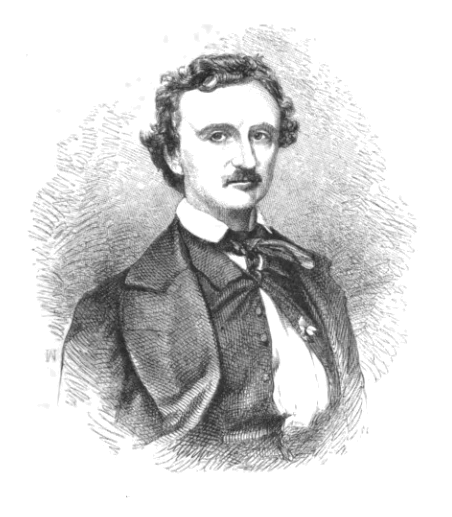
In person Edgar Allan Poe was slight, and hardly of the medium height; his motions were quick and nervous, his air was abstracted, and his countenance generally serious and pale. He never laughed, and rarely smiled; but in conversation he was vivacious, earnest, and respectful; and though he appeared generally under restraint, as though guarding against a half-subdued passion, yet his manners were engaging, and he never failed to win the confidence and kind feelings of those with whom he conversed for the first time; and there were a few who knew him long and intimately who could never believe that he was ever otherwise than the pleasant, intelligent, respectful, and earnest companion he appeared to them. Though he was at times so reckless and profligate in his conduct, and so indifferent to external proprieties, he was generally scrupulously exact in everything he did. He dressed with extreme neatness and perfectly good taste, avoiding all ornaments and everything of a bizarre appearance. He was painfully alive to all imperfections of art; and a false rhyme, an ambiguous sentence, or [page xxx:] even a typographical error, threw him into an ecstasy of passion. It was this sensitiveness to all artistic imperfections, rather than any malignity of feeling, which made his criticisms so severe, and procured him a host of enemies among persons towards whom he never entertained any personal ill-will. He criticised his own productions with the same severity that he exercised towards the writings of others; and all his poems, though he sometimes represented them as offsprings of a sudden inspiration, were the work of elaborate study. His handwriting was always neat and singularly uniform, and his manuscripts were invariably on long slips of paper about four inches wide, which he never folded, but always made into a roll. Nothing he ever did had the appearance of haste or slovenliness, and he preserved with religious care every scrap he had ever written, and every letter he ever received, so that he left behind him the amplest materials for the composition of his literary life. At his own request these remnants of his existence were entrusted to Doctor Griswold, a gentleman with whom he had quarrelled, and had lampooned in his lectures; Doctor Griswold, in a generous spirit, accepted the charge, and produced from the papers entrusted to him, the best biography of the strange being that has been published, which was appended to the collection of his works in four volumes issued in New York.
June, 1857.
∞∞∞∞∞∞∞
Notes:
The authorship of this memoir has been somewhat debated, and thus remains less than fully conclusive. James B. Reece attributes it to Briggs “confidently” (p. 258) with some additional argument in a footnote (n33), largely based on similar phrasing between the memoir and Briggs’ 1877 article on “The Personality of Poe.” The memoir is listed under Briggs’ name in the Dameron and Cauthen Edgar Allan Poe: A Bibliography of Criticism, 1827-1967, p. 48, tentatively, but with no supporting discussion. Mrs. Whitman asked John H. Ingram in 1874 if he knew who wrote the 1858 memoir, and Ingram replied that he thought it was Briggs, without further explanation. At this point, Ingram was in contact with W. J. Widdleton, who was the successor to J. S. Redfield. No name other than that of Briggs has been credibly suggested.
∞∞∞∞∞∞∞
[S:0 - PWEAP, 1858] - Edgar Allan Poe Society of Baltimore - A Poe Bookshelf - Memoir of Edgar Allan Poe (C. F. Briggs (?), 1858)