“Ye who read are still among the living, but I who write shall have long since gone my way into the region of shadows. For indeed strange things shall happen, and many secret things be known, and many centuries shall pass away, ere these memorials be seen of men. And, when seen, there will be some to disbelieve, and some to doubt, and yet a few who will find much to ponder upon in the characters here graven with a stylus of iron.” — from Edgar Allan Poe's “Shadow — a Parable” (1835).


The Collected Works of Edgar Allan Poe
A Comprehensive Collection of E-Texts
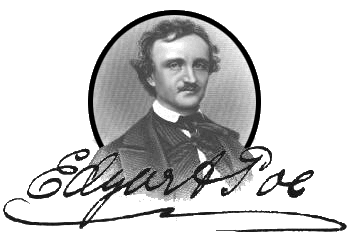
Poe's Works of Poetry & Fiction:
- Poe's Poems (“Alone,” “The Raven,” etc.)
- Poe's Tales (“The Fall of The House of Usher,” etc.)
Poe's Works of Non-Fiction:
- Poe's Letters (including letters from and to Poe, with a checklist)
- Poe's Literary Criticism (Reviews and Notices)
- Poe's Essays, Sketches & Lectures (Eureka, “The Philosophy of Composition,” etc.)
- Poe's Miscellanea (“Marginalia,” “The Literati,” etc.)
- Miscellaneous Documents and Manuscript Material
Important and Scholarly Collections of Poe's Writings:
- The Works of Edgar Allan Poe (edited by Edmund Clarence Stedman and George Edward Woodberry, 10 volumes, 1894-1895). This collection was the first serious attempt at a scholarly edition. Although rather conservative in regard to its selection of material, specifically omitting material that was questionable or which the editors did not deem worthy of public attention, it does include all of the most important works and collected a number of items for the first time. It also provided a useful set of introductory essays, notes (mostly on bibliographical matters) and a variorum edition for the poems (inclusive of what was known at the time).
- The Complete Works of Edgar Allan Poe (edited by James Albert Harrison, 17 volumes, 1902). Although far from truly complete, and including several things that Poe did not write, this set was the standard scholarly edition of Poe's works for more than fifty years, and is still a commonly used reference for the criticism.
- The Collected Works of Edgar Allan Poe (edited by Thomas Ollive Mabbott, Poems, Tales and Sketches — the definitive annotated scholarly edition of Poe's poetry, tales and sketches). The series long planned by Mabbott was continued after his death as The Collected Writings of Edgar Allan Poe (chiefly edited by Burton R. Pollin), including The Imaginary Voyages (The Narrative of Arthur Gordon Pym, The Journal of Julius Rodman and The Adventures of Hans Phaall), The Brevities (including “Marginalia,” “Pinakidia,” etc.), Nonfictional Prose in the Broadway Journal and Nonfictional Prose in the Southern Literary Messenger. Two additional volumes were issued on Eureka and Edgar Allan Poe, Critical Theory: The Major Writings (edited by Stuart and Susan Levine).
- The Collected Letters of Edgar Allan Poe (edited by John Ward Ostrom, Burton R. Pollin and Jeffrey A. Savoye, 2 volumes, 1948, 1966 and 2008). Although these three editions certainly do not include every letter that Poe wrote, they do include the known text of every letter that was available at the time the edition was published. A few letters not included have been identified since 2008, and the text of those letters is present in the online collection of letters.
About Poe's Works:
- Poe's Works in Annuals, Magazines and Periodicals (first printings and recorded reprintings)
- Some Editions of Poe's Works
- Editorial Policies and Methods for Preparing Texts
- Searching the Collected Works (via Google)
- The Canon of Poe's Works (Poems, Tales, etc.) (under construction)
Other Links:
∞∞∞∞∞∞∞
∞∞∞∞∞∞∞
Notes:
Author.............: Edgar Allan Poe (1809-1849) (Except where otherwise noted.)
Site Author......: The Edgar Allan Poe Society of Baltimore, Inc.
Created...........: April 4, 1998
Last update.....: March 9, 2026
∞∞∞∞∞∞∞
It is presumed that Poe's works, widely published for over 150 years, are part of the public domain and that no copyright laws have been violated in posting this material. Anyone is free to use information from this site for any legitimate purpose without charge as long as sources are properly noted. (Links to this site are welcome, and educational or artistic uses are encouraged. Wholesale lifting of our text or images, however, is not permitted — nor is the unacknowledged use of this material for student papers or commercial endeavors.) Schools may print and distribute any number of copies of these materials for use in class without special permission.
∞∞∞∞∞∞∞
Although substantially complete, various parts of this site are still under construction, and new material is constantly being added. Providing comprehensive and reliable information takes time, so please bear with us. (Proofreading pages, particularly historical items, requires considerable effort, and is likely to be a perpetual task.) We are currently in the process of giving the site a bit of a facelift, as noted at the end of our main menu.
∞∞∞∞∞∞∞
[S:1 - JAS] - Edgar Allan Poe Society of Baltimore - The Works of Edgar Allan Poe