∞∞∞∞∞∞∞
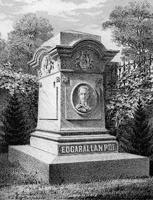
Lithograph of Poe's Memorial Grave (in Baltimore, Maryland), shortly after its unveiling in 1875. (From S. S. Rice, A Memorial Volume, 1877.)
When Poe was originally buried in 1849, he was placed in an unmarked grave. Over the years, the site became overgrown with weeds. Eventually, George W. Spence (the Sexton), placed there a small block of sandstone, bearing a carved number “80” (Phillips, Poe the Man, p.1512). Reports of Poe’s anonymous and unkempt grave began to circulate, first privately then in the newspapers. In 1860, Maria Clemm wrote to Neilson from Alexandria, Virginia, “A lady called on me a short time ago from Baltimore. She said she had visited my darling Eddie’s grave. She said it was in the basement of the church, covered with rubbish and coal. Is this true? Please let me know. I am certain both he and I have still friends left to rescue his loved remains from degradation” (letter from Maria Clemm to Neilson Poe, August 1860, reprinted in J. C. Miller, Building Poe Biography, pp. 46-49). This note of concern seems to have spurred Neilson to action. He appears to have assured Mrs. Clemm that Poe was buried in the family lot and that he would take care that the grave was better maintained. Shortly after, he ordered a marble headstone, which was in the process of being carved by Hugh Sisson. Due to the weight of the stones and the difficulty of moving them, the monument yard was next to the railroad line. Before it could be installed, the recently completed stone was destroyed in an accident in which a train ran off the tracks and directly through the yard. Not being a wealthy man, Neilson did not order a second stone. It survives only in a pencil sketch by Charles H. Dimmock. (See Images, below.)
By 1865, a movement had begun, under the leadership of Miss Sara Sigourney Rice, to provide for a new monument to Baltimore’s neglected poet. Through a combination of pennies accumulated by students, gifts from friends and a variety of benefits, half of the necessary amount was raised by 1871. The remainder was donated by Mr. George W. Childs of Philadelphia in 1874. The monument was designed by George A. Frederick, who was also the architect for Baltimore’s City Hall, and executed by the same Hugh Sisson who had worked once before on Poe’s behalf. This time only one accident befell his creation — Poe’s birthday is erroneously given as January 20 rather than January 19. (Although several possibilities were suggested by the likes of Oliver Wendell Holmes and James R. Lowell, the new monument has no epitaph, only the names and dates of its occupants.) After some discussion on the most appropriate location for the imposing edifice, it was decided that it would be best to use the front corner of the cemetery. (The church, built around 1855, would have blocked the view of the grave from the street if Poe was left in his grandfather’s lot. There was also a small problem of securing rights to enough surrounding space, most of which was already occupied.)
The monument was dedicated on November 17, 1875. Among those in attendance were John H. B. Latrobe (one of the judges who awarded Poe the Baltimore Saturday Visiter prize in 1833), Judge Neilson Poe (Edgar’s cousin) and Walt Whitman (the great American poet, who actually met Poe once). Letters from H. W. Longfellow, John G. Whittier, William C. Bryant and Alfred Tennyson were read. The remains of Virginia Poe, buried in 1847 in New York, were brought to Baltimore and added to those of Poe and Maria Clemm in 1885. (Technically, Virginia’s remains were buried next to the monument, on the south side. A ceremony was performed by Rev. J[ohn]. S[abastian]. B[ach]. Hodges (1830-1915), rector of St. Paul’s Protestant Episcopal Church, on January 19, 1855. Also present at the ceremony was Sara S. Rice, and Virginia’s remains were reburied by the same George W. Spence who had buried Poe in 1849 and supervised his reburial in 1875.) Thus the three who had struggled together as a family for so many years were reunited for eternity.
In 1913, Orrin C. Painter placed another stone, intended to mark Poe’s original burial site, in the rear of the church. For uncertain reasons, this stone was initially misplaced completely outside of the Poe family lot. It was quickly moved to a more reasonable but still dubious location. Perhaps in part due to this confusion, but mostly because people simply love a good mystery, a strange rumor has persisted that the memorial committee failed to exhume Poe’s remains, instead moving those of some other poor soul. The improbability of this notion is obvious when one realizes that the exhumation in 1875 was supervised by George W. Spence, the man who buried Poe in 1849, and Poe’s cousin Neilson Poe, who attended the original funeral. In the intervening 25 years, both men had frequently been called upon to take visitors to see Edgar’s grave and were unlikely to have had the opportunity to forget the correct spot. Although no headstone ever marked Poe’s grave, the cemetery itself is quite small and the traditional site of the grave is framed by the marble slab of the Reverend Patrick Allison at the left and a prominent mausoleum behind.
∞∞∞∞∞∞∞
Description:
The marble part of the monument measures 80 inches tall, to the peak, and tapers downward from 34 inches to 46 inches wide. (The top ornamentation measures 4 feet from point to point.) The square granite base on which it sits measures 6 feet on each side. The area in front and around the grave was originally just a grassy plot, but has long since been replaced by a brick walkway. (Sometime in the late 1920s, the area around the momument was flattened and paved with flagstone. The flagstone was replaced by brick in the early 1980s, as part of the rennovation of the building and grounds.)
The front of the monument features a bas-relief bust of Poe, with the dates 1809 and 1849. (The original portrait of Poe was carved in statuary marble by Frederick Volck. Over the years, the soft marble became terribly weathered and worn. It was replaced in 1938 with a newer copy, cast in bronze. This copy was stolen in the late 1970s and again replaced. The original medalion is now on display in the catacombs of the church.)
Poe’s full name is given in capital letters on the base. Each of the other sides carries a different inscription: (North side) “Maria Poe Clemm; Born; March 17, 1790; Died; February 16, 1871”; (West side) “Edgar Allan Poe; Born; January 20 [sic], 1809; Died; October 7, 1849”; (South side) “Virginia Clemm Poe; Born; August 15, 1822; Died; January 30, 1847.” (The incorrect date of Poe’s birth was engraved. He was born on January 19 not 20.)
∞∞∞∞∞∞∞
The Poe Toaster
Beginning in 1949 (or possible somewhat earlier), on the night of the anniversary of Poe’s birth (as January 18th becomes January 19th), a mysterious stranger has entered this cemetery and left as tribute a partial bottle of cognac and three roses on Poe’s grave. (A newspaper article from the Baltimore Sun in 1950 includes a minor mention of the visitor leaving such items, conclusively documenting that it began at least in 1949.) Although some early members of the church recalled in the 1970s that it may have started in the 1930s, the year 1949 is more widely accepted, and the date of 1949 would be significant as the 100th anniversary of the year Poe died. (That date, however, would also be a little clumsy as it would necessarily conflate the month and year of his death, in October 1849, with the month of his birth, in January.) The identity of the stranger, referred to affectionately as the “Poe Toaster,” is unknown. The significance of cognac is uncertain as it does not feature in Poe’s works as would, for example, amontillado. The presumption for the three roses is that it represents the three persons whose remains are beneath the monument: Poe, his wife (Virginia Clemm Poe), and his mother-in-law (Maria Clemm). Out of respect, no attempt is made to stop or hinder him. Several of the bottles of cognac from prior years are kept at the Baltimore Poe House and Museum.
The statement occasionally made that the identity must be known by the Poe Society of Baltimore is utterly untrue, no matter how confident may be the tone of the person stating it. Similarly, Jeff Jerome, the curator of the Baltimore Poe House and Museum, has consistently denied having any such knowledge, although he freely admits to having intentionally withheld some minor details about the event for the sake of differentiating between the “Toaster” and would-be imitators. (None of these details are of a nature that might allow for such an identity to be traced back to a person who could then be named.) The fact that even these official entities do not possess such information, of course, inherently complicates any attempt to conclusively assign a name. Thus far, however, none of the suggestions for the identity of this person have fit the recognized details, and he therefore remains unknown, as does his precise motivation for starting — and devotion in continuing — this long-standing mission.
A note left for Jeff Jerome in 1993 stated somewhat cryptically that “the torch will be passed,” and another note left in 1999 indicated that the original “Toaster” had died within a few months before the annual event. After 1993, sightings of the visitor suggested two younger persons were exchanging the obligation between themselves, presumably in honor of their father. The annual visitations continued through 2009, the bicentennial of Poe’s birth, but not in subsequent years. On January 19, 2012, after three successive years in which there was no appearance from the “Toaster,” Jeff Jerome officially declared that the original tradition had ended. Various individuals have taken it upon themselves to leave similar tokens, and some have hoped that they might be able to assume the same recognition and continue the tradition, although they have generally been referred to somewhat dismissively as “Faux Toasters.” As there is no authoritative body other than the person who appears to have originated the tradition, and those he has designated, and no such transfer of authority has occurred, all such attempts to restart a new tradition must be taken purely on their own merits.
∞∞∞∞∞∞∞
∞∞∞∞∞∞∞
Tours of Westminster Burying Grounds and Catacombs:
April-November: 1st and 3rd Fridays of each month. (Reservations are required as tours may be canceled for insufficient enrollment.) Special tours may be arranged for groups of 15 or more people: www.westminsterhall.org/tours.
There is an admission charge for all tours.
The cemetery gates are generally open to the public, daily 8:00 a.m. to dusk.
The former church, now called Westminster Hall, is available for weddings, receptions and other events.
Phone: (410) 706-2072 (an answering machine handles calls outside business hours.)
The grave, church and cemetery currently belong the Law School of the University of Maryland and are maintained by the Westminster Preservation Trust.
∞∞∞∞∞∞∞
Directions:
Westminster Hall and Poe’s grave are in the southeast corner of Fayette and Greene Streets. (See map under Images.)
From the Poe House on Amity Street: Continue south on Amity to the end of the block. Turn left on Lexington to the first traffic light, which is Fremont. Turn right on Fremont and follow for 2 blocks south to Baltimore Street. Turn left on Baltimore and go 3 blocks to Paca. (The University of Maryland Hospital will be on your left and the Veterans Hospital on your right.) Turn left on Paca and stay in the left lane. Go one block and turn left on Fayette, heading west. The next street is Greene. Westminster Hall and the Poe Grave are immediately on the left, at the corner.
From the Inner Harbor, south of town: Take Charles Street (one way) north to Fayette. Turn left on Fayette. Follow Fayette to Greene. Westminster Hall and the Poe Grave are immediately on the left, at the corner.
Parking: Metered parking is available on the street. (The meters take quarters. Do not go beyond Greene Street on Fayette looking for metered parking as this is likely to take you far out of your way.) For off-street parking, turn left on Greene for one block. Turn left on Baltimore and continue to the traffic light. Turn left on Paca and there is a garage (payment is required) on the right.
Note: Use caution when parking in an urban environment. Common sense dictates that you lock your car and keep any valuables out of sight.
∞∞∞∞∞∞∞
∞∞∞∞∞∞∞
- Bittinger, Lucy Forney, “The Westminster Graveyard, Baltimore, Maryland,” (this is a small, anonymous and undated pamphlet of 10 pages, printed in Baltimore by Kohn & Pollack, Inc. The date is probably 1924, based on a Nov. 13, 1924 letter from J. H. Whitty to Kenneth Rede requesting a copy of the pamphlet. The original letter is in the special collections of the Enoch Pratt Free Library, Kenneth Rede Collection, folder 4. The pamphlet, with a slip of paper stating “Mr. J. H. Whitty with the compliments of Kenneth Rede” is in a private collection. Another copy of what appears to be the same pamphlet is in the May G. Evans collection at Johns Hopkins University, bearing the inscription “with the compliments of the author” and signed Lucy Forney-Bittinger. Although some sources give her dates as 1859-1907, and she was indeed born in 1859, she was still alive as late as 1930, and is listed in the Federal Census for that year as living in Baltimore and noted as a Deaconess. She was a missionary to China as late as 1921, and was a member of the Westminster Presbyterian Church. According to her tombstone in Hanover, PA, she died in Baltimore in 1955.)
- Bready, James H., “Westminster Presbyterian Church Marks Two Milestones This Year,” Baltimore Evening Sun, September 22, 1950, p. 31. (The portion relevant to the discussion of the Poe Toaster follows: “The anonymous citizen who creeps in annually to place an empty bottle (of excellent label) against the tomb of Poe, on the anniversary of his death, is a jokester, Mr. McDonald figures.” Rev. Bruce H. McDonald was the minister for the Church in 1950. Mr. Bready, who died in 2011, admitted in personal conversations in the 1980s that he was probably in error in citing the event as occurring on the anniversary of Poe’s death rather than his birth, as the event was not as well-known at the time as it was to become in later years. Whether by “empty” Rev. McDonald meant “fully empty” or merely “partially empty” must remain a matter of conjecture at this point.)
- Didier, Eugene L., “The Grave of Poe,” Appleton’s Journal, VII, Jan 27, 1872, p. 104.
- Didier, Eugene L., “Account from Baltimore of Monument to Be Erected Over Poe’s Grave,” Appleton’s Journal, XIII, May 15, 1875, p. 629.
- Dugdale, Jennie Bard, “The Grave of Edgar Allan Poe,” Poet-Lore, XI, 1899, pp. 583-595.
- French, John C., “The Day of Poe’s Burial,” BaltimoreSun, June 3, 1949, p. 14.
- Miller, John C., “The Exhumations and Reburials of Edgar and Virginia Poe and Mrs. Clemm,” Poe Studies, December 1974, pp. 46-47.
- Pouder, G. H., “Poe of Baltimore,” Baltimore, Vol. XLII, No. 11, September 1949, pp. 16-22.
- Rice, Sara Sigourney, Edgar Allan Poe: A Memorial Volume, Baltimore: Turnbull Brothers, 1877.
- Wilson, Jane Bromley, The Very Quiet Baltimoreans: A Guide to the Historic Cemeteries and Burial Sites of Baltimore, White Mane Publishing Company, 1991. (See the chapter “Westminster Burying Ground” on pp. 1-6, preceded by a full-page map of the cemetery.)
∞∞∞∞∞∞∞
∞∞∞∞∞∞∞
[S:1 - JAS] - Edgar Allan Poe Society of Baltimore - Baltimore - Poe’s Memorial Grave